
SEATTLE INTERNATIONAL BUTOH FESTIVAL 2026
Friday 11/20
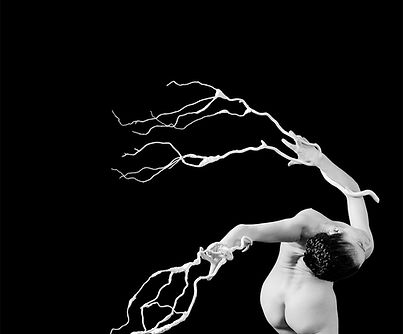
Maureen Fleming
AXIS MUNDI
Conceived and performed by Maureen Fleming
Light and visual design by Christopher Odo
Videography by Christopher Odo and Jeff Bush
Sound design by Brett Jarvis
Music by Philip Glass, Somei Satoh, James Mahon and Michael Harrison
In this solo, Fleming explores transcendence through the physical form.

Maureen Fleming
A Conversation with Maureen Fleming
Moderated by Helen Thorsen
An artist talk on the environment and the impact of artificial intelligence on our planet.
Friday Bios
MAUREEN FLEMING (Choreographer/Dance Artist) is renowned for her original form of visual theater realized through choreography for photography, video, and live performance. Fleming connects cultures and art forms in an interdisciplinary celebration of femininity and the universality of the soul’s journey. A Guggenheim Fellow and Fulbright Scholar to Ireland, South Korea, Colombia and Latvia, her solo and group works: After Eros, Decay of the Angel, Waters of Immortality, B. Madonna,Wildflowers, A Feminine Genesis, The Alchemist’s Veil and Axis Mundi have toured spanning five continents including the Spoleto Festival in Italy, FILO Festival Brazil, Performing America’s Tour Colombia, Argentina and Uruguay, the O’Shaughnessy Women of Substance Series in St. Paul, Jacob’s Pillow Festival, Emerson Majestic and Institute of Contemporary Art in Boston and La MaMa, Irish Arts Center, the Kitchen and NY City Center Fall for Dance Festival in NYC. Born in Japan to American parents, the effects of a severe accident when Fleming was two years old have influenced her approach to movement. The accident left a bone spur and the loss of the disc between her 4th and 5th vertebrae, a condition that would confine most people to a wheelchair. Her distinctive slow-motion style involves twisting the body into extreme positions, where the blood builds up and stops, and then slowly untwists, allowing the blood to flow more quickly, creating a kind of cleansing. With a strong belief in the body’s regenerative powers, Fleming explores the evolution of her wounds. Her choreography emphasizes aligning the body’s spiritual center while using the female body as a symbol for the earth’s cycles of regeneration. She brings the discipline of a classicist and the imagination of an iconoclast to her unique style of movement inspired by her studies in Japan with Kazuo Ohno, the co-founder of butō. Fleming went on to perform with his son, Yoshito Ohno in Eros, and to tour internationally with performance artist and choreographer Min Tanaka. Fleming continued her training in the US under the Cecchetti master Margaret Craske. Since 1994, she has conducted workshops including the Juilliard School, N.Y.U. Tisch School of the Arts, Brown University, Rhode Island School of Design, and the Seoul Institute of the Arts. Fleming Elastxx received a US patent in 2020 and in 2024, Fleming completed the first “book choreography” titled Maureen Fleming under the auspices of the Guggenheim Fellowship.
“She seemed to transcend the material world and enter the realm of pure spirit...wondrous choreographic
metamorphosis.”
The New York Times
“A sensation of danger, of a violence, of a revelation still remains there: that mixing of life and death, of image and flesh…that make us a human being, and that Fleming’s courage opens for a moment into a fascinating and hypnotic wound.”
La Repubbilca, Italy
CHRISTOPHER ODO (Light and Visual Designer) A National Endowment for the Humanities Scholar and a recipient of a Fulbright Commission in South Korea, Odo has worked as a designer and performer with Maureen Fleming Company in the USA, Asia, Europe and South America. Designs and performances include New York’s City Center Fall for Dance Festival, Jacob’s Pillow Festival and festivals in Italy, Mexico, Iceland, France, Germany, Russia, and at La MaMa E.T.C., Cleveland Museum, Virginia Museum, Emerson Majestic Theater and Institute for Contemporary Art in Boston among others. Before joining Maureen Fleming Company, he performed with butō artist Min Tanaka in Delphi, danced with Solaris/Lakota, a cross-cultural project with Native American artists in the USA, Africa, France and Sweden. He performed Puck in A Midsummer Night’s Dream at the Public Theater and Lincoln Center Institute and danced in the original Tony award winning M. Butterfly directed by John Dexter.
BRETT R. JARVIS (Sound Designer) Brett worked with Maureen Fleming in her works: After Eros, Decay of the Angel, Wildflowers, A Feminine Genesis, and The Alchemist’s Veil. His career has spanned theatre, dance, opera, orchestras, installations, consultation, show control integration, and video design. Theatrical credits include: Andrew Lloyd Webber’s Masquerade, Bullet for Adolf (New World Stages, Written and Directed by Woody Harrelson), The Train Driver (Signature Theatre), and Baby Universe (Drama Desk Nomination 2011) The Burnt Part Boys (New York Stage and Film), The Glass Menagerie (Guild Hall), The Slug Bearers of Kayroll Island (Vineyard Theatre), Speech and Debate (Roundabout Theatre Company), Revolution (Joyce Theatre), Kiki and Herb—Alive on Broadway!, Two Trains Running (2007 Audelco Award Nomination), Landscape of the Body and The Trip to Bountiful (Signature Theatre), and The Best of Both Worlds (American Repertory Theatre). Other selected works include People Be Heard (Playwrights Horizons), Bill Irwin’s Mr. Fox: A Rumination (Signature Theater), Avenue Q (Lucille Lortel Award 2003), Brutal Imagination (Lucille Lortel Nomination 2002), Mark Dendy’s Dream Analysis, the long running hit The Donkey Show.
Saturday 11/21

Joan Laage / Kogut Butoh
the Gardener (2012) - film
Film created by Karolina Bieszczad
Performed by Joan Laage/Kogut Butoh
This is the first of three short films created by Karolina featuring Joan in Oslo, Norway where Karolina lives. Two of the films have been shown at the Dance Film Festival in Seattle. Karolina’s dissertation at a UK university focused on butoh photography.

Robyn Bjornson
[Title TBD]
Performed by Robyn Bjornson
Music by [TBD]
[Short description to come.]

Vanessa Skantze
[Title TBD]
[Description to come]

Helen Thorsen and Mary Cutrera
Tether - now we are old
Directed by Helen Thorsen
Performed by Mary Cutrera and Helen Thorsen, with Leatha McKenzie, Suzanne Parenteau, Amy Ward
Music by Andrew Anderson

Dhyana Garcia-Snyder
Omakase (2026)
Created by Dhyana Garcia-Snyder
Music by ?
Dhyana returns from a month-long Butoh immersion in Japan, where she studied with masters Moe Yamamoto and Kei Shirasaki. Tonight she presents an “omakase” performance – a curated selection of the work she cultivated during her travels. Please join her after the performance; she would love to hear your impressions.
Saturday Bios
Joan Laage / Kogut Butoh studied with Kazuo Ohno and Yoko Ashikawa in Tokyo and performed with Ashikawa’s group Gnome. She founded Dappin’ Butoh in Seattle in 1990. Known as Kogut since her time in Krakow, Laage creates site-specific performances for Seattle’s Japanese gardens and tours in Europe. She appears in Karolina Bieszczad’s film the Gardener.
Dhyana Garcia-Snyder is a Seattle-based performing artist from Mexico City and a founding member of DAIPANbutoh Collective. She discovered butoh in 2005 and names Diego Piñón as her foundational teacher. With an MFA and more than 30 years of movement experience, she brings ballet, contemporary dance, butoh, and embodied mindfulness to her practice. Her solo Omakase draws on a month of study in Japan with Moe Yamamoto and Kei Shirasaki.
Helen Thorsen directs and performs Tether with Mary Cutrera. She began studying butoh with Eiko and Koma in 1981 and danced with Joan Laage’s Dappin’ Butoh from 1991 to 2000. In Seattle she has created work for theaters, a car, and the streets of Pioneer Square. She co-founded LastLeg Dance with Cutrera in 2003 and founded Butoh Tacoma in 2022.
Mary Cutrera was a founding member of Dappin’ Butoh under Joan Laage. She has performed with Aono Jikken, The Fisher Ensemble, Manifold Motion, and the Cabiri. A regular performer at the Seattle International Butoh Festival, she shares a long creative partnership with Helen Thorsen.
Andrew Anderson is a Portland-based sound artist. He builds compositions from field recordings, hidden samples, destroyed tape, and electronic and acoustic instruments. Quiet repetition, drone, and gradual change run through his work. His music accompanies Tether.
Sunday 11/22

Dhyana Garcia-Snyder
Pilgrimage of Surrender - film (2026)
Directed by Juliet Mcmains
A meditation on surrender, yielding to grief and play, the wisdom of the land and our capricious nature as humans. Filmed at Dry Falls, Washington, it reveals how tenderness can still emerge from the deepest ruptures. This film belongs to the performance trilogy Pilgrimage of Pulse (2025), and Pilgrimage of Pulse - Syzygy (2026).

Kaoru Okumura
The Distant Shore
Stage art by Hiroko Nagatomo
Between the seen and the unseen I stay,
a thread of silence tying night to day.
In breathless air I feel the far shore near—
I tie the knot, then rise, and disappear.

Sheri Brown
WAKING
Choreographed & performed by Sheri Brown
with creative support from Raph Laigo & Isobel Davis
WAKING follows the journey described in the passages of the Shiva Sutras. It continues the journey of Anchor in the Field (of Becoming).

Performed by workshop participants
[Title TBD]
[Description to come]
Sunday Bios
Dhyana Garcia-Snyder is a Seattle-based performing artist from Mexico City and a founding member of DAIPANbutoh Collective. She discovered butoh in 2005 and names Diego Piñón as her foundational teacher. With an MFA and more than 30 years of movement experience, she brings ballet, contemporary dance, butoh, and embodied mindfulness to her practice. She appears in Pilgrimage of Surrender, filmed at Dry Falls, Washington.
Juliet McMains directed Pilgrimage of Surrender. A professor in the University of Washington Department of Dance, she researches, teaches, and makes work about improvisational dance and its theatrical expression. Her dance films have screened at festivals in Buenos Aires, San Francisco, Puerto Rico, and Rosario.
Kaoru Okumura is a Japanese butoh performer based in Seattle. Her journey began in the 1970s. In 1993 she trained under Akiko Motofuji at Tokyo’s Asbestos-Kan, where she made her debut. Her work includes a Google Deep Dream project supported by Google Artists & Machine Intelligence and Orasho - The Prayers of Nagasaki, broadcast at Colombia’s Festival Cuerpo Vibrátil in 2020. She performed at the 16th International Dance+Theater Festival in Tokyo in 2024 and tours Japan annually. kaoruokumura.com
Hiroko Nagatomo creates stage art for The Distant Shore. A multidisciplinary artist working in ink, watercolor, and acrylics, she explores nature, emotion, and movement through color, texture, and form. Her scenography extends this practice into performance spaces.
In WAKING, Sheri Brown embodies the nearshore, blurring the boundaries between human form and marine ecology to explore what it means to experience the sea as consciousness, embody the flowing motion of kelp, and generate abundance through the friction of the ecotone. Sheri weaves her investigation of the Shiva Sutras with the study of life's layers in pursuit of truth and awakening.
Developed and choreographed by Sheri Brown from an original concept by Raphael Laigo, WAKING integrates video art by Isobel Davis, a sound score created and edited by Brown from Laigo's musical selections, and Brown's own sculptural installation, Constellation Rack—a chandelier resurrected from her P.A.N. Crosspollination project of 2002. These elements converge in a living environment of movement, image, sound, and transformation.Sheri Brown Dance: sheribrowndance.com
Isobel Davis is the video artist for Sheri Brown’s WAKING. Her video draws the audience into the nutrient-rich waters of the Salish Sea, where the movement of a kelp forest becomes part of the dance. For Davis, kelp is an active verb. Its blades trail like ribbons in the current and dance with storms. She imagines the forest as a form of consciousness, enriching the sea around it the way awareness touches everything. Within WAKING, these images invite the audience to feel the movement of the water in their own bodies.
Kelp forests feed and shelter marine life. Davis traces the historic “kelp highways,” where the paths of migrating fish and the ancestral journeys of Indigenous peoples meet. At the shoreline, she brings two worlds into view at once. Below the surface, the forest sways with the tide. Above it, industrial cranes mark the city’s rapid growth. Davis sees in this meeting place an echo of the friction, change, and resilience we experience in our own lives and communities.


